
A sudden twist of the knee, an unexpected popping sensation, or persistent knee instability can be signs of an Anterior Cruciate Ligament (ACL) injury. These injuries are common among athletes and physically active individuals, but they can also occur during everyday activities, accidental falls, or sudden changes in direction.
The ACL plays an important role in maintaining knee stability. When this ligament is injured, walking, climbing stairs, running, or participating in sports may become uncomfortable or difficult.
For individuals considering ACL Surgery in PCMC, understanding the symptoms, treatment options, surgical procedure, and recovery process can help them make informed decisions.
At PanOrtho Hospital, located in Nigdi Pradhikaran, Pimpri-Chinchwad, orthopedic services include arthroscopy, sports injury management, and rehabilitation.
What Is an ACL Injury?
The Anterior Cruciate Ligament is one of the major ligaments connecting the thigh bone (femur) to the shin bone (tibia). It helps control forward movement and rotation of the knee.
An ACL injury occurs when this ligament is stretched beyond its normal capacity or torn due to sudden movements or excessive force.
Common causes include:
- Sudden twisting or pivoting movements
- Landing awkwardly after jumping
- Rapid changes in direction while running
- Direct impact during contact sports
- Falls or accidental knee injuries
ACL injuries can range from mild sprains to complete ligament tears. The severity of the injury influences the recommended treatment.
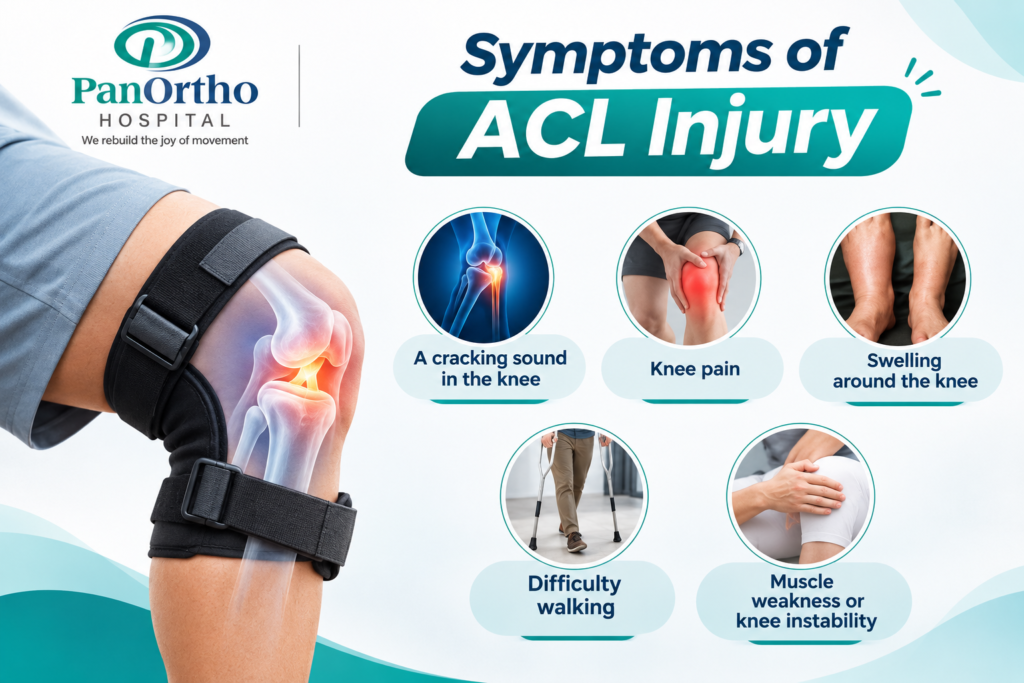
What Are the Common Symptoms of an ACL Injury?
Recognizing the warning signs can help individuals seek timely orthopedic evaluation.
1. Popping Sensation in the Knee
Some individuals experience or hear a popping sound at the moment of injury. This can occur when the ACL tears, although not every knee pop indicates ligament damage.
2. Knee Pain
Pain may develop immediately after injury and can make standing, walking, or bending the knee uncomfortable.
3. Swelling Around the Knee
Rapid swelling within the first few hours after injury is a common sign of significant ligament damage.
4. Difficulty Walking
An injured ACL can affect knee stability, making it difficult to walk comfortably or bear weight on the affected leg.
5. Knee Instability
Some patients experience a sensation that the knee may suddenly give way, particularly while turning, changing direction, or walking on uneven surfaces.
If these symptoms occur following an injury, an orthopedic consultation is advisable.
Does Every ACL Injury Require Surgery?
Not every ACL injury requires an operation.
The decision depends on several factors, including the severity of the tear, knee stability, activity level, associated injuries, and individual treatment goals.
Patients with partial ACL tears and stable knees may benefit from nonsurgical treatment.
Nonsurgical Treatment Options
Depending on the injury, treatment may involve:
- Physiotherapy to improve muscle strength
- Rehabilitation exercises to restore movement
- Temporary activity modification
- Knee bracing when clinically appropriate
- Pain and swelling management
However, patients with complete ACL tears, repeated knee instability, or associated ligament and meniscus injuries may be advised to consider surgical reconstruction.
When Is ACL Surgery Recommended?
ACL Surgery in PCMC may be considered when the injured ligament significantly affects knee function or stability.
Surgery may be recommended for individuals who:
- Experience repeated episodes of knee instability
- Have complete ACL tears with functional limitations
- Participate in sports involving jumping, pivoting, or sudden changes in direction
- Have associated meniscus or other ligament injuries
- Require stable knee function for physically demanding work
- Continue to experience instability despite appropriate rehabilitation
The decision should follow a detailed clinical assessment and discussion of the benefits, risks, and alternatives.
How Is ACL Reconstruction Surgery Performed?
ACL reconstruction is commonly performed using an arthroscopic surgical technique.
Arthroscopy is a minimally invasive procedure in which a small camera and specialized surgical instruments are introduced through small incisions around the knee.
During ACL reconstruction, the surgeon generally:
- Examines the knee joint and identifies the injured structures.
- Assesses the damaged ACL and any associated injuries.
- Prepares a tendon graft to replace the torn ligament.
- Positions the graft through carefully created bone tunnels.
- Secures the graft using suitable fixation devices.
- Checks knee stability and graft positioning.
The graft may be obtained from the patient’s own hamstring, quadriceps, or patellar tendon. In selected circumstances, donor tissue may be considered.
The surgeon determines the most suitable graft and surgical approach based on the patient’s age, activity level, anatomy, and individual requirements.
What Are the Potential Benefits of ACL Reconstruction?
When surgery is clinically indicated, ACL reconstruction aims to restore knee stability and improve functional movement.
Potential benefits include:
- Improved knee stability
- Reduced episodes of the knee giving way
- Better ability to perform daily physical activities
- Support for returning to selected sports and recreational activities
- Reduced risk of some additional injuries associated with repeated instability
However, surgical outcomes vary between patients. ACL reconstruction also carries potential risks, including infection, blood clots, stiffness, persistent pain, graft failure, and incomplete restoration of function.
Successful recovery depends on the surgery, rehabilitation, and the patient’s individual progress.
How Long Does Recovery Take After ACL Surgery?
Recovery after ACL reconstruction is gradual and requires a structured rehabilitation program.
First Few Weeks: Pain and Swelling Management
The initial stage generally focuses on reducing swelling, improving knee extension, restoring muscle activation, and gradually improving movement.
Crutches or a knee brace may be recommended depending on the surgical procedure and associated injuries.
1 to 3 Months: Improving Strength and Mobility
Physiotherapy focuses on restoring knee movement, strengthening surrounding muscles, improving walking patterns, and developing balance.
3 to 6 Months: Functional Rehabilitation
Selected patients gradually progress to more demanding strengthening, balance, and functional exercises.
Running or higher-impact activities should begin only after appropriate clinical and rehabilitation assessment.
6 to 12 Months or Longer: Return to Sports
Returning to competitive sports may take approximately 6 to 12 months or longer.
The decision depends on strength, knee stability, movement quality, psychological readiness, and functional testing rather than time alone.
Patients with associated meniscus injuries or other complications may require modified rehabilitation schedules.
Why Is Physiotherapy Important After ACL Surgery?
Physiotherapy is a major component of recovery following knee ligament reconstruction.
Even when surgery successfully restores the ligament’s mechanical stability, surrounding muscles need time and appropriate training to regain strength and control.
Rehabilitation may help:
- Restore knee flexibility and movement
- Strengthen quadriceps and hamstring muscles
- Improve balance and coordination
- Restore functional walking patterns
- Support a safe return to everyday activities
- Reduce the risk of avoidable reinjury
Patients should follow their orthopedic surgeon’s and physiotherapist’s recommendations throughout recovery.
ACL Injury Evaluation at PanOrtho Hospital in PCMC
Choosing appropriate treatment begins with identifying the nature and severity of the injury.
PanOrtho Hospital, located in Nigdi Pradhikaran, Pimpri-Chinchwad, provides orthopedic services covering sports injuries, arthroscopy, joint conditions, and rehabilitation.
During an ACL injury consultation, an orthopedic specialist may assess:
- The circumstances of the knee injury
- Pain, swelling, and instability
- Knee movement and ligament stability
- Associated meniscus or cartilage injuries
- Functional requirements and activity goals
An MRI may be recommended when necessary to assess ligament damage and associated knee injuries.
Based on the findings, treatment may involve physiotherapy, activity modification, or consideration of ACL reconstruction surgery.
Frequently Asked Questions About ACL Surgery
Can an ACL tear heal without surgery?
Some patients can regain satisfactory knee function without surgery, particularly when the knee remains stable. However, a completely torn ACL generally does not heal back to its original structure and strength on its own.
Is ACL surgery painful?
Pain and discomfort are expected after surgery, but medications, cold therapy, and rehabilitation strategies can help manage symptoms. Individual experiences vary.
Can I walk after ACL surgery?
Many patients begin walking with appropriate support relatively early after reconstruction. The timing and permitted weight-bearing depend on the procedure and any associated injuries.
Can I return to sports after ACL reconstruction?
Many patients return to sports following successful rehabilitation. However, clearance depends on knee strength, stability, functional testing, and individual recovery.
How do I know whether I need ACL surgery?
An orthopedic specialist evaluates ligament damage, knee stability, activity requirements, and associated injuries before recommending surgery or nonsurgical management.
Conclusion
An ACL injury can significantly affect knee stability, confidence in movement, and participation in physical activities. Recognizing early symptoms and receiving an appropriate diagnosis can help prevent repeated instability and guide effective treatment.
Although not every ACL injury requires surgery, patients with significant instability or associated injuries may benefit from ACL reconstruction.
For individuals seeking ACL Surgery in PCMC, PanOrtho Hospital offers orthopedic consultation and services related to knee injuries, arthroscopy, and rehabilitation.
Consult PanOrtho Hospital for ACL injury assessment, knee ligament treatment, and personalized orthopedic guidance.
 Select an element to maximize. Press ESC to cancel.