
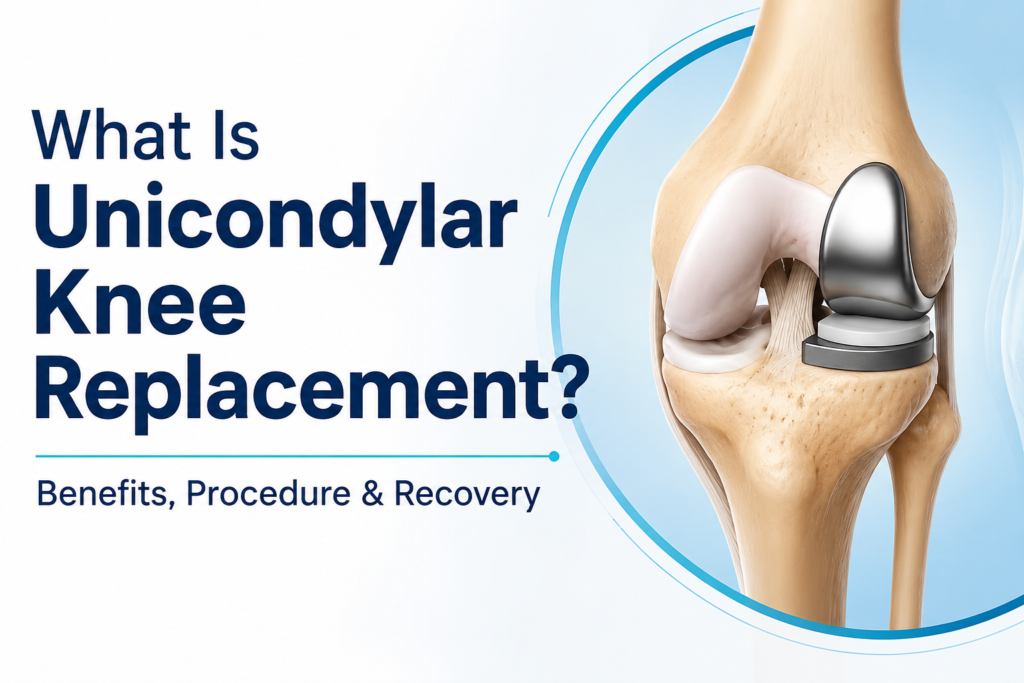
What Is Unicondylar Knee Replacement?
If knee pain caused by osteoarthritis is affecting your daily life, climbing stairs, or walking comfortably, you may not always need a total knee replacement. At PanOrtho Hospital, Nigdi, PCMC, advanced orthopedic treatments such as Unicondylar Knee Replacement (UKR), also known as Partial Knee Replacement, help patients with arthritis limited to one compartment of the knee regain mobility with less pain and faster recovery. This bone-preserving procedure replaces only the damaged portion of the knee while preserving healthy cartilage, ligaments, and bone.
Key Takeaways
Unicondylar Knee Replacement (UKR) is a minimally invasive knee replacement surgery that replaces only the damaged compartment of the knee while preserving the healthy cartilage, ligaments, and bone. It is recommended for patients with early to moderate osteoarthritis affecting a single compartment of the knee.
What Is Unicondylar Knee Replacement?
The knee has three compartments:
- Medial (inner)
- Lateral (outer)
- Patellofemoral (front)
When arthritis affects only one compartment, replacing the entire knee may not be necessary. In Unicondylar Knee Replacement, only the damaged compartment is replaced with a specially designed implant while the remaining healthy knee structures are preserved.
This results in more natural knee movement and improved function.
Who Is a Good Candidate for Unicondylar Knee Replacement?
You may be a suitable candidate if you have:
- Osteoarthritis limited to one compartment
- Persistent knee pain despite medications and physiotherapy
- Difficulty walking or climbing stairs
- Good knee stability
- Healthy knee ligaments, especially the ACL
- Minimal knee deformity
A detailed clinical examination and imaging studies help determine whether UKR is the right option.
Benefits of Unicondylar Knee Replacement
Compared with total knee replacement, UKR offers several advantages:
Smaller Incision
Less tissue damage and minimally invasive surgery.
Faster Recovery
Most patients begin walking soon after surgery and recover more quickly.
Less Blood Loss
Reduced surgical trauma often means less blood loss.
Better Range of Motion
Preserving healthy knee structures helps maintain natural movement.
Less Pain After Surgery
Many patients experience less postoperative discomfort.
Shorter Hospital Stay
Patients often return home earlier than after total knee replacement.
More Natural Knee Function
Since most of the knee remains intact, many patients report the knee feels more natural.
How Is the Procedure Performed?
During surgery:
- The damaged cartilage and bone are removed.
- Healthy ligaments and unaffected cartilage are preserved.
- A metal and medical-grade polyethylene implant replaces the damaged compartment.
- The knee alignment and movement are carefully restored.
The procedure usually takes 60–90 minutes, depending on the patient’s condition.
Recovery After Unicondylar Knee Replacement
Recovery is generally faster than total knee replacement.
Typical recovery timeline:
Day 1
- Standing and walking with assistance.
2–6 Weeks
- Gradual improvement in mobility.
- Physiotherapy focuses on strength and flexibility.
6–12 Weeks
- Most patients return to routine daily activities.
3–6 Months
- Continued improvement in strength and knee function.
Recovery varies depending on age, overall health, and adherence to rehabilitation.
What Are the Risks?
Like any surgery, UKR has potential risks, including:
- Infection
- Blood clots
- Implant loosening over time
- Persistent pain or stiffness
- Progression of arthritis in other compartments
- Need for revision surgery in some patients
These complications are uncommon when surgery is performed after proper patient selection and followed by appropriate rehabilitation.
Unicondylar Knee Replacement vs Total Knee Replacement
| Feature | Unicondylar Knee Replacement | Total Knee Replacement |
|---|---|---|
| Bone Removed | Only damaged compartment | Entire knee joint |
| Recovery | Faster | Longer |
| Hospital Stay | Usually shorter | Usually longer |
| Knee Movement | More natural | Excellent but less natural |
| Suitable For | Single-compartment arthritis | Advanced arthritis involving multiple compartments |
Frequently Asked Questions (FAQs)
Is unicondylar knee replacement permanent?
The implants are designed to last many years. Longevity depends on activity level, implant quality, and overall knee health.
Is partial knee replacement better than total knee replacement?
For appropriately selected patients with arthritis confined to one compartment, partial knee replacement can provide excellent outcomes while preserving healthy knee structures.
How long does recovery take?
Many patients resume normal daily activities within 6–12 weeks, although complete recovery continues over several months.
Can I walk after surgery?
Yes. Most patients begin walking within a day after surgery under medical supervision.
Will I need physiotherapy?
Yes. Physiotherapy is an essential part of recovery and helps restore strength, flexibility, and function.
Conclusion
Unicondylar Knee Replacement is an excellent option for patients with arthritis confined to a single compartment of the knee. By preserving healthy bone and ligaments, this procedure offers quicker recovery, less postoperative pain, and more natural knee movement compared to total knee replacement in appropriately selected patients.
If you are experiencing persistent knee pain or have been advised to consider knee replacement surgery, consult an orthopedic specialist for a comprehensive evaluation.
For expert diagnosis and advanced Unicondylar Knee Replacement treatment visit PanOrtho Hospital, Nigdi, PCMC. Our expert orthopedic team provide personalized care using modern joint replacement techniques to help you return to an active, pain-free lifestyle. For more information visit our website or book an appointment.