
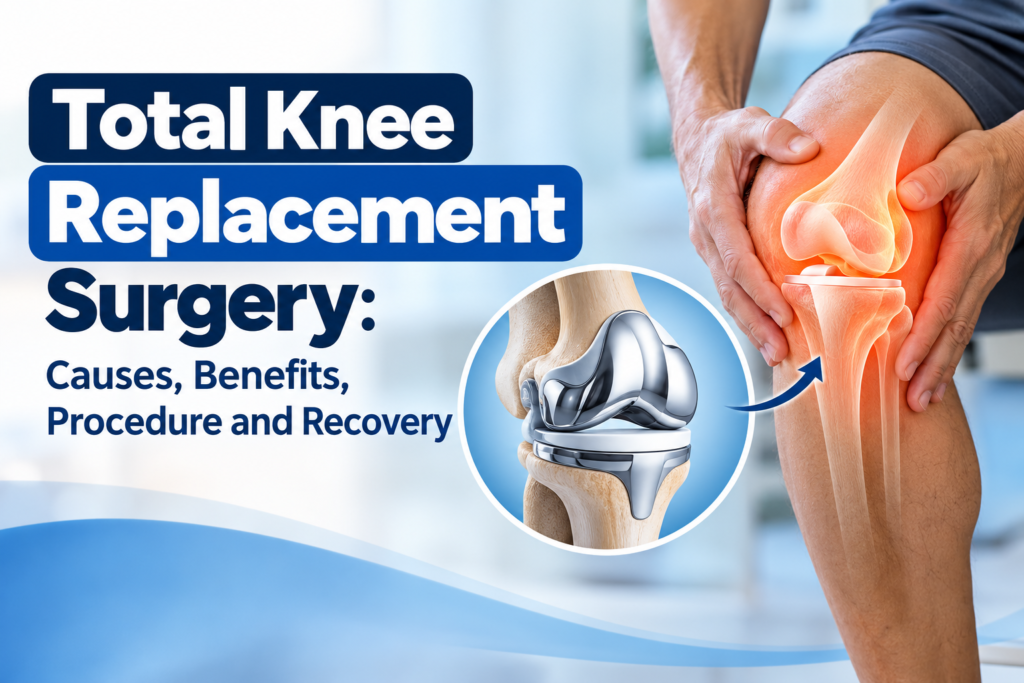
Persistent knee pain and stiffness can make walking, climbing stairs, getting up from a chair, and other daily activities difficult. When advanced knee joint damage continues despite appropriate non-surgical treatment, total knee replacement surgery may be considered to relieve pain and improve knee function.
If knee pain or stiffness is affecting your daily life, consult an orthopedic specialist for proper evaluation and diagnosis. For patients in PCMC, PanOrtho Hospital provides specialist guidance on knee replacement surgery and other suitable treatment options.
Total knee replacement, also called total knee arthroplasty (TKA), involves replacing damaged parts of the knee joint with artificial components. It is most commonly performed for advanced knee osteoarthritis and may also be recommended for other conditions causing significant joint damage.
This guide covers the causes, benefits, procedure, recovery, risks, and frequently asked questions about total knee replacement surgery.
What Is Total Knee Replacement Surgery?
Total knee replacement is a surgical procedure in which damaged surfaces of the knee joint are removed and replaced with artificial components, typically made from metal and durable plastic materials.
The knee is formed primarily by the lower end of the thigh bone (femur), upper end of the shin bone (tibia) and kneecap (patella). In a total knee replacement, the damaged surfaces are prepared and replaced with prosthetic components that allow the joint to move more smoothly. In some patients, the underside of the kneecap may also be resurfaced.
The goal is not simply to replace the joint. The overall aim is to reduce pain, improve mobility and help the patient return to daily activities.
Why Does Someone Need Total Knee Replacement?
The most common reason for total knee replacement is advanced osteoarthritis of the knee. Osteoarthritis gradually damages cartilage and other joint structures, which can lead to pain, stiffness, swelling and reduced movement.
Other conditions that may contribute to severe knee damage include:
- Rheumatoid arthritis and other inflammatory forms of arthritis
- Arthritis that develops after a previous knee injury
- Significant joint damage following trauma
- Severe deformity of the knee
- Progressive loss of knee function despite appropriate treatment
However, having arthritis or knee pain does not automatically mean that knee replacement is necessary. Surgery is generally considered when symptoms are significant, the joint is substantially damaged and appropriate non-surgical treatments have not provided sufficient relief.
Common Symptoms That May Indicate Advanced Knee Damage
Patients with severe knee arthritis may experience:
- Persistent knee pain
- Pain while walking or standing
- Knee stiffness, particularly after periods of inactivity
- Swelling around the knee
- Difficulty climbing or descending stairs
- Difficulty getting up from a chair
- Reduced walking distance
- A feeling of instability or the knee giving way
- Difficulty performing routine daily activities
- Knee pain that interferes with sleep
Osteoarthritis symptoms can gradually become more limiting as joint damage progresses.
When Is Total Knee Replacement Recommended?
Total knee replacement is usually considered after a thorough assessment rather than based on age or an X-ray alone.
An orthopedic specialist may consider surgery when:
- Knee pain is persistent or severe and significantly affects daily life.
- Knee function has deteriorated, making walking and routine activities difficult.
- Imaging shows significant joint damage consistent with the symptoms.
- Non-surgical treatments have not provided adequate relief.
- The patient’s overall health and medical conditions have been assessed and surgery is considered appropriate.
Non-surgical treatment may include exercise and physiotherapy, weight management when appropriate, medications and selected injections. The appropriate treatment depends on the patient’s condition and medical history.
Is There a Specific Age for Knee Replacement?
There is no single age at which everyone should undergo total knee replacement. The decision is based primarily on the severity of symptoms, joint damage, functional limitations, overall health and expected benefits of surgery.
An orthopedic surgeon can help determine whether knee replacement is appropriate for an individual patient.
What Happens Before Total Knee Replacement Surgery?
Before surgery, the orthopedic team evaluates the knee and the patient’s general health.
This may include:
- Medical history and symptom assessment
- Physical examination of the knee
- X-rays and, when clinically indicated, other imaging
- Blood tests or other medical investigations
- Assessment of existing medical conditions
- Medication review
- Pre-operative anesthesia assessment
X-rays can help identify changes such as loss of joint space, bone changes and bone spurs associated with osteoarthritis.
Patients should also discuss existing medical conditions, previous operations, medications and any history of problems with anesthesia with their healthcare team before surgery.
How Is Total Knee Replacement Surgery Performed?
The exact technique can vary depending on the patient’s anatomy, degree of joint damage, implant selection and the surgeon’s approach.
In general, the procedure involves the following steps:
1. Anesthesia
The patient receives anesthesia appropriate for the procedure and their medical condition. This may include spinal or general anesthesia.
2. Surgical Access
The surgeon makes an incision over the knee to access the damaged joint surfaces.
3. Removal of Damaged Joint Surfaces
The damaged portions of the femur and tibia are carefully prepared to accommodate the artificial components.
4. Placement of the Implants
Artificial components are positioned on the prepared surfaces of the femur and tibia. These components are designed to provide a smooth, stable articulating surface.
5. Assessment of Knee Movement
The surgeon checks alignment, stability and movement of the knee before completing the procedure.
6. Closure
The surgical incision is closed and a dressing is applied.
A total knee replacement procedure commonly takes around one to two hours, although the duration can vary according to individual circumstances and surgical complexity.
What Are the Benefits of Total Knee Replacement?
For appropriately selected patients, total knee replacement can provide significant improvement in pain and physical function.
Potential benefits include:
- Reduction in severe arthritis-related knee pain
- Improved ability to walk
- Better knee function for everyday activities
- Improved mobility
- Greater independence in daily activities
- Improved quality of life
The results vary between individuals and depend on factors such as overall health, muscle strength, rehabilitation and adherence to post-operative guidance.
What Is Recovery Like After Total Knee Replacement?
Recovery is a gradual process rather than an overnight change.
Patients are usually encouraged to begin moving the knee and walking with assistance soon after surgery, under the guidance of the healthcare and physiotherapy team. Walking aids such as a walker or crutches may initially be required.
Early Recovery
During the early period after surgery, the focus generally includes:
- Pain management
- Wound care
- Controlling swelling
- Safe walking
- Knee movement exercises
- Preventing complications
- Beginning physiotherapy
Physiotherapy and Exercise
Physiotherapy plays an important role in recovery. Exercises are individualized to improve knee movement, strength and function.
Following the prescribed rehabilitation programme consistently can support recovery and help patients gradually return to everyday activities.
How Long Does Total Knee Replacement Recovery Take?
Recovery varies from person to person. Many patients can gradually increase their activities over the first several weeks, but full recovery may take several months or longer depending on age, general health, muscle strength, rehabilitation and the complexity of surgery.
Patients should follow their surgeon’s individual instructions regarding walking, driving, work, exercise and other activities.
What Are the Risks of Total Knee Replacement?
Total knee replacement is a commonly performed procedure, but like any major surgery, it has potential risks.
Possible complications include:
- Infection
- Blood clots or deep vein thrombosis (DVT)
- Bleeding
- Injury to nearby nerves or blood vessels
- Persistent pain or stiffness
- Limited knee movement
- Instability of the knee
- Problems involving the implant
- Need for additional surgery in some cases
The risk varies according to factors such as age, general health and individual medical conditions.
Patients should discuss the expected benefits and potential risks with their orthopedic surgeon before making a treatment decision.
How Long Does a Knee Replacement Last?
Modern knee replacements are designed to provide long-term function. However, the lifespan of an implant varies between individuals and can be influenced by factors such as activity level, body weight, implant type and overall health.
Current patient information from the NHS notes that knee replacements can last around 25 years, although this does not mean every implant will last exactly that long.
Total Knee Replacement vs Partial Knee Replacement
A total knee replacement replaces the damaged surfaces of the major compartments of the knee, whereas a partial knee replacement replaces only the affected compartment when the disease is appropriately localized.
Not every patient with knee arthritis is suitable for partial replacement. The choice depends on the location and extent of joint damage, ligament function, symptoms and other clinical factors.
Your orthopedic surgeon can determine which procedure is more appropriate after examining the knee and reviewing imaging.
How Can Patients Prepare for Knee Replacement Surgery?
Preparing for surgery can help patients understand the recovery process and participate actively in rehabilitation.
Depending on individual circumstances, preparation may include:
- Completing recommended medical tests
- Reviewing current medications with the healthcare team
- Optimizing existing medical conditions
- Maintaining appropriate physical activity before surgery
- Strengthening the muscles around the knee where advised
- Planning assistance at home during the early recovery period
- Understanding the physiotherapy programme
- Arranging follow-up appointments
Patients should always follow the specific instructions provided by their surgical and medical team.
Frequently Asked Questions About Total Knee Replacement
Is total knee replacement a major surgery?
Yes. Total knee replacement is a major orthopedic operation that requires surgical preparation, anesthesia, post-operative care and rehabilitation. It is commonly performed and can provide significant improvement for appropriately selected patients.
Is knee replacement surgery painful?
Pain and discomfort are expected after surgery, but modern pain-management strategies are used to control symptoms. Pain generally changes as recovery progresses, and physiotherapy is an important part of rehabilitation.
How soon can I walk after total knee replacement?
Many patients begin walking with assistance soon after surgery under the supervision of healthcare professionals and physiotherapists. The exact timeline depends on individual recovery and the surgeon’s recommendations.
Can I climb stairs after knee replacement?
Many patients can return to using stairs as recovery progresses. Initially, assistance and specific techniques may be recommended. Your physiotherapist will guide you based on your strength, balance and knee movement.
Can I drive after total knee replacement?
Driving should only be resumed when you are medically fit, have adequate control of the vehicle and can safely perform emergency movements. The timing varies by patient and should be confirmed with the treating doctor.
Is knee replacement the only treatment for severe knee arthritis?
No. Treatment depends on the severity of arthritis and individual symptoms. Exercise, physiotherapy, weight management, medication and selected injections may be considered before surgery. When symptoms remain severe and joint damage is advanced, knee replacement may be an appropriate option.
Does everyone with knee arthritis need a knee replacement?
No. Many people with knee osteoarthritis can manage their symptoms without surgery. Total knee replacement is generally considered when pain and functional limitations are significant and other appropriate treatments have not provided adequate relief.
When should I consult an orthopedic specialist in PCMC?
Consider an orthopedic evaluation if persistent knee pain, stiffness or reduced mobility is interfering with walking, climbing stairs, sleep, work or routine activities—particularly when symptoms are progressively worsening.
Conclusion
Total knee replacement surgery is primarily considered for patients with significant knee joint damage and persistent symptoms that substantially affect daily life, particularly when appropriate non-surgical treatments have not provided sufficient relief.
A successful outcome depends not only on the surgical procedure but also on appropriate patient selection, pre-operative assessment, post-operative care and rehabilitation.
If persistent knee pain is limiting your mobility or daily activities, visit Panortho Hospital in PCMC, where our orthopedic specialist can assess the condition, determine the cause of symptoms and explain whether non-surgical treatment, partial knee replacement or total knee replacement may be appropriate.
Medical Disclaimer
This article is intended for general educational purposes and does not replace an examination or personalized medical advice. Treatment decisions should be made after evaluation by a qualified orthopedic specialist.