
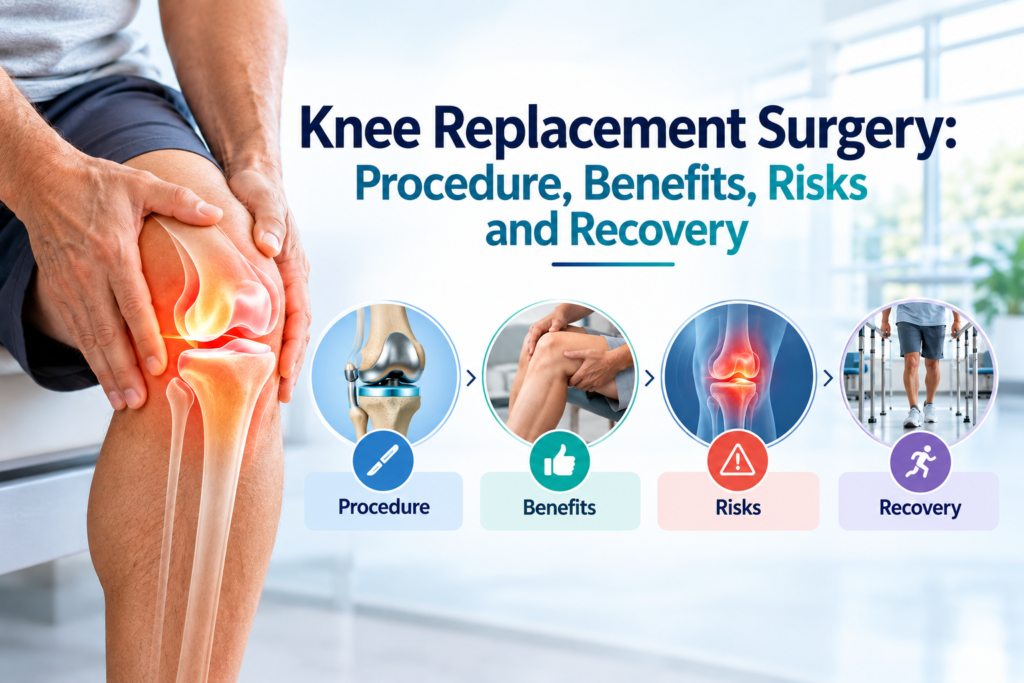
Persistent knee pain can make everyday activities such as walking, climbing stairs, getting up from a chair, or even sleeping comfortably difficult. While many knee problems can be managed with medicines, physiotherapy, exercise, weight management, or injections, severe joint damage may eventually require surgical treatment.
Knee replacement surgery is a commonly performed orthopedic procedure used to relieve pain and improve function in people with significant damage to the knee joint. It is most often considered when symptoms substantially affect daily life and appropriate non-surgical treatments no longer provide adequate relief.
If you are experiencing persistent knee pain, joint pain, stiffness, or other orthopedic concerns that are affecting your daily activities, consider consulting an experienced orthopedic specialist. Visit PanOrtho Hospital, a leading orthopedic hospital in PCMC, for proper evaluation, diagnosis, and personalized treatment.
What Is Knee Replacement Surgery?
Knee replacement, also called knee arthroplasty, is a surgical procedure in which damaged surfaces of the knee joint are removed and resurfaced with artificial components.
The procedure does not usually involve replacing the entire knee as a single structure. Instead, the surgeon removes damaged cartilage and a small amount of underlying bone from the affected joint surfaces. These surfaces are then covered with metal components, and a medical-grade plastic spacer is placed between them to allow smooth movement.
Depending on the extent and location of joint damage, a patient may require a total knee replacement or partial knee replacement.
Why Is Knee Replacement Surgery Performed?
One of the most common reasons for knee replacement is osteoarthritis. This condition causes progressive breakdown of the cartilage that normally allows the bones within the knee to move smoothly.
Other conditions that may significantly damage the knee include:
- Rheumatoid arthritis
- Post-traumatic arthritis following a serious knee injury
- Certain knee deformities
- Osteonecrosis in selected cases
- Severe joint damage causing persistent pain and loss of function
Surgery is generally considered based on symptoms, examination findings, imaging, overall health, and response to previous treatment rather than an X-ray finding alone.
Signs That Knee Replacement May Be Considered
Not everyone with knee arthritis requires surgery. An orthopedic evaluation may be appropriate when a person experiences persistent symptoms such as severe pain during walking or other daily activities, pain at rest or during the night, significant stiffness, reduced mobility, difficulty climbing stairs, or progressive limitation of normal activities.
Visible bowing or other knee deformity can occur in advanced arthritis as well.
Importantly, the decision to undergo surgery should be individualized. The severity of pain and its effect on quality of life are important considerations alongside clinical and imaging findings.
What Happens During Knee Replacement Surgery?
Before surgery, the orthopedic team evaluates the patient’s medical history, medications, general health, knee movement, joint stability, and imaging studies. Preoperative blood tests and other investigations may also be required.
During the operation, anesthesia is administered so that the patient remains comfortable. The surgeon accesses the knee joint and removes the damaged cartilage and a controlled amount of bone.
The surfaces of the femur (thigh bone) and tibia (shin bone) are carefully prepared. Artificial components are positioned to restore the joint surfaces, with a durable plastic insert between the metal components. The kneecap may also be resurfaced in some patients depending on the surgical findings and technique.
The surgeon then checks alignment, stability, and movement before closing the incision.
Total Knee Replacement vs Partial Knee Replacement
In a total knee replacement, multiple damaged compartments of the knee are resurfaced. This is commonly performed when arthritis affects a large portion of the joint.
A partial knee replacement replaces only the affected compartment while preserving more of the patient’s natural bone, cartilage, and ligaments.
Partial replacement is suitable only for selected patients whose arthritis is limited to a particular area of the knee. An orthopedic surgeon determines suitability after clinical assessment and imaging.
Benefits of Knee Replacement Surgery
The primary goals of knee replacement are to reduce pain and improve mobility and function.
Potential benefits include:
- Significant reduction in arthritis-related knee pain
- Improved ability to walk and perform daily activities
- Better knee function
- Correction of certain deformities
- Greater independence in everyday activities
- Improved quality of life for appropriately selected patients
Results vary between individuals, and surgery cannot guarantee a completely pain-free or perfectly normal knee.
What Are the Risks of Knee Replacement?
Like any major operation, knee replacement has potential complications. Although many patients recover without serious problems, understanding these risks is an important part of informed decision-making.
Possible complications include infection, blood clots in the legs or lungs, bleeding, stiffness, persistent pain, nerve or blood vessel injury, wound-healing problems, instability, and problems involving the implant.
Over time, artificial components can also wear or loosen. In some situations, another operation known as revision knee replacement may eventually be required.
Individual risk varies according to factors such as age, overall health, weight, smoking status, diabetes control, previous surgery, medications, and other medical conditions.
Recovery After Knee Replacement Surgery
Recovery begins soon after surgery. Patients are generally encouraged to start moving under medical supervision relatively early because appropriate mobilization helps restore function and can reduce certain postoperative complications.
A physiotherapist typically guides exercises designed to improve knee movement, muscle strength, balance, and walking ability. During the early recovery period, patients may use a walker or other walking aid. Pain, swelling, stiffness, and bruising around the knee are common after surgery and generally improve gradually.
The speed of recovery differs considerably between patients.
Physiotherapy After Knee Replacement
Rehabilitation is an important part of recovery. Exercises may focus on improving the ability to straighten and bend the knee, strengthening the quadriceps and surrounding muscles, restoring a safe walking pattern, and improving overall mobility.
Patients should follow the rehabilitation program recommended by their surgeon and physiotherapist rather than increasing exercise intensity without guidance.
Consistency with rehabilitation can play an important role in achieving functional recovery.
How Long Does Knee Replacement Recovery Take?
There is no single recovery timeline that applies to everyone.
Many patients gradually return to basic daily activities during the first several weeks, while strength, flexibility, endurance, and confidence may continue improving for several months.
Recovery depends on several factors, including the patient’s health before surgery, muscle strength, severity of joint disease, type of procedure, surgical technique, complications, and adherence to rehabilitation.
Patients should follow their own surgeon’s advice regarding driving, returning to work, climbing stairs, exercise, and other activities.
How Long Does a Knee Replacement Last?
Modern knee replacements are designed for long-term use, but no artificial joint can be guaranteed to last for life.
Implant longevity depends on several factors, including the patient’s age, activity level, body weight, implant characteristics, surgical factors, and overall health.
Regular follow-up with the orthopedic surgeon can help monitor the condition and function of the replaced joint.
Activities After Knee Replacement
Following recovery, many patients can return to activities such as walking, swimming, cycling, and other appropriate low-impact exercises after receiving medical clearance.
High-impact activities involving repetitive jumping, forceful twisting, or excessive loading may not be suitable for every patient.
The safest level of activity should be discussed with the treating orthopedic surgeon based on the patient’s implant, recovery, and individual circumstances.
Can Knee Replacement Be Avoided?
In early or moderate knee arthritis, surgery may not be immediately necessary. Depending on the underlying condition, treatment may include weight management when appropriate, physiotherapy, muscle-strengthening exercises, activity modification, pain-relieving medicines, and selected injections.
However, these treatments cannot reverse advanced loss of joint cartilage. When severe arthritis causes persistent pain and major functional limitations despite appropriate conservative treatment, knee replacement may become a treatment option.
Frequently Asked Questions
Is knee replacement surgery painful?
Pain and swelling are expected after surgery, particularly during the early recovery period. Modern anesthesia, pain-management strategies, medication, and rehabilitation are used to help control postoperative discomfort.
Can I walk after knee replacement?
Patients are commonly encouraged to begin standing and walking with professional assistance relatively early after surgery when medically appropriate. The exact timing depends on the patient’s condition and surgeon’s protocol.
Can both knees be replaced?
Bilateral knee replacement may be considered for selected patients with significant arthritis in both knees. It is not suitable for everyone, and the potential benefits and risks require individual medical assessment.
Is there an age limit for knee replacement?
There is no universal age that automatically determines whether someone can or cannot have knee replacement. The decision is generally based on symptoms, joint damage, overall health, functional limitations, and expected benefits and risks.
When should I consult an orthopedic surgeon?
Persistent knee pain, increasing stiffness, reduced walking ability, progressive deformity, night pain, or difficulty performing routine activities warrants medical evaluation, particularly when symptoms are not improving with conservative treatment.
Conclusion
Knee replacement can be an effective treatment for people with severe knee joint damage whose pain and loss of mobility continue despite appropriate non-surgical care. The procedure aims to reduce pain, restore useful movement, and improve everyday function.
However, the decision to undergo surgery should be based on an individualized orthopedic assessment rather than pain severity or imaging findings alone. Understanding the procedure, realistic benefits, potential risks, and rehabilitation process can help patients make an informed decision about their treatment.
If knee pain is progressively interfering with walking, sleep, work, or routine activities, an orthopedic consultation in PCMC can help determine the cause and whether non-surgical treatment or knee replacement is appropriate.