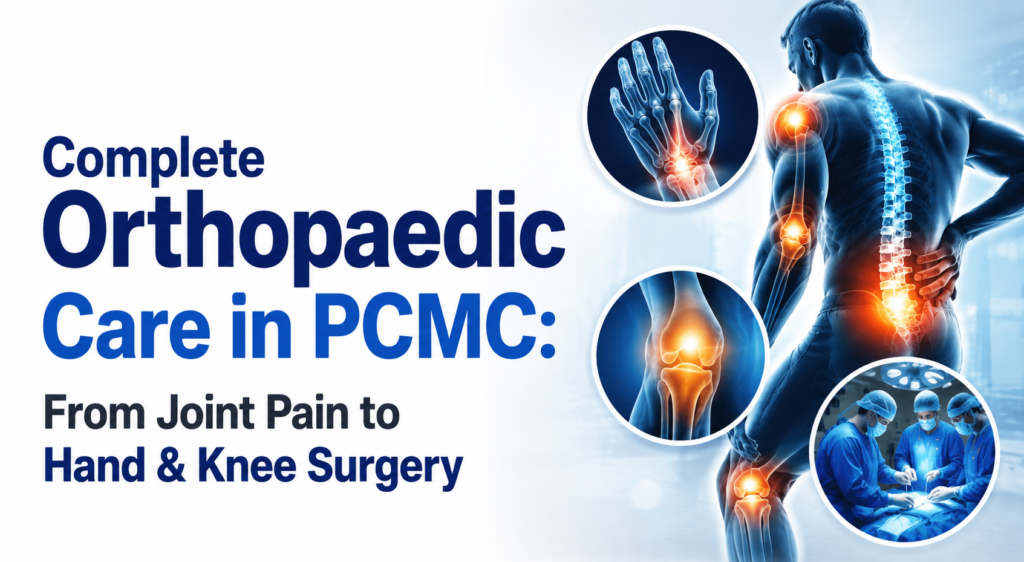
Orthopaedic problems can affect your mobility, strength, and ability to perform everyday activities. From persistent joint pain and sports injuries to conditions requiring knee replacement, arthroscopy, hand surgery, or spine treatment, timely diagnosis can help guide appropriate care.
For people looking for orthopaedic care in PCMC and Pimpri Chinchwad, access to comprehensive evaluation and treatment can make managing musculoskeletal conditions more convenient and coordinated.
What Does Orthopaedic Care Include?
Orthopaedic care focuses on conditions affecting the bones, joints, muscles, ligaments, tendons, and spine. Depending on the diagnosis, treatment may include medication, physiotherapy, activity modification, injections, minimally invasive procedures, or surgery.
Common conditions treated by orthopaedic specialists include:
- Knee, hip, and shoulder problems
- Arthritis and degenerative joint conditions
- Sports injuries
- Ligament and tendon injuries
- Fractures and trauma
- Back and spine conditions
- Hand and wrist problems
- Foot and ankle disorders
Knee and Joint Care in PCMC
Knee pain can make walking, climbing stairs, exercising, and other daily activities difficult. The cause may range from arthritis and cartilage damage to ligament injuries or trauma.
Treatment depends on the underlying problem and its severity. It may include:
- Medication and activity modification
- Physiotherapy and rehabilitation
- Injections in selected cases
- Arthroscopic procedures
- Joint replacement surgery
Knee Replacement Surgery
For patients with advanced knee joint damage, knee replacement surgery in PCMC may be considered when persistent pain and reduced mobility significantly affect quality of life and conservative treatment is no longer providing adequate relief.
Depending on the extent and location of joint damage, options may include:
- Total knee replacement
- Unicondylar or partial knee replacement
The appropriate procedure is determined after a detailed clinical assessment and imaging evaluation.
Hip and Shoulder Replacement
Joint damage can also affect the hip and shoulder, leading to pain, stiffness, and reduced function.
Hip replacement surgery may be considered for severe joint damage caused by conditions such as advanced arthritis or certain injuries. Similarly, shoulder replacement surgery may be recommended for selected patients with significant shoulder joint damage.
The goal of joint replacement is to reduce pain and improve joint function when other treatment options are no longer sufficient.
Sports Injury Treatment in PCMC
Sports injuries can involve the ligaments, tendons, muscles, cartilage, and joints. Common injuries include ACL tears, meniscus injuries, shoulder injuries, and ligament or tendon damage.
Early assessment can help determine the extent of an injury and whether treatment should involve rehabilitation, medication, activity modification, or surgery.
For patients looking for sports injury treatment in PCMC, an individualized evaluation can help determine the appropriate treatment and recovery plan.
Arthroscopy for Selected Joint Problems
Arthroscopy is a minimally invasive surgical technique that uses a small camera to examine and treat problems inside a joint.
It may be used for selected conditions affecting the knee, shoulder, and other joints, including certain:
- ACL and ligament injuries
- Meniscus tears
- Cartilage problems
- Shoulder injuries
- Joint-related conditions
An arthroscopy surgeon in PCMC can assess whether this approach is appropriate based on the patient’s condition and imaging findings.
Hand Surgery and Microsurgery
Hand and wrist problems can affect grip, strength, sensation, and everyday activities. Depending on the condition, treatment may be required for fractures, tendon injuries, nerve compression, ligament injuries, and other structural problems.
A hand surgery specialist in PCMC can evaluate the condition and recommend appropriate non-surgical or surgical treatment.
For selected complex injuries, microvascular surgery may be required to repair or preserve small blood vessels and other delicate structures.
Spine and Back Pain Treatment
Back and neck pain can have several causes, including muscle strain, disc-related problems, degenerative changes, spinal injuries, and other conditions.
Many cases of back pain can be managed with non-surgical treatment. However, some patients may require further investigation or surgical treatment depending on the underlying cause.
If you are experiencing persistent back pain in PCMC, an appropriate evaluation can help identify the cause and determine the next step.
Foot and Ankle Orthopaedic Care
Foot and ankle problems can affect walking, balance, sports performance, and daily activities. Conditions may include fractures, ligament injuries, arthritis, tendon problems, and certain deformities.
Treatment can range from conservative management and rehabilitation to procedures such as foot and ankle surgery or ankle replacement when clinically appropriate.
When Should You See an Orthopaedic Specialist?
An orthopaedic evaluation may be appropriate if you experience:
- Persistent or worsening joint pain
- Difficulty walking or moving a joint
- Recurrent sports injuries
- Joint swelling or stiffness
- Reduced range of motion
- Persistent back or neck pain
- Hand or wrist pain affecting daily activities
- Pain or reduced function following an injury
- Difficulty performing routine activities because of musculoskeletal pain
Early assessment can help identify the underlying cause and guide appropriate treatment.
Choosing an Orthopaedic Hospital in PCMC
When searching for an orthopaedic hospital in PCMC, consider factors such as:
- Range of orthopaedic services
- Diagnostic and imaging facilities
- Availability of surgical and non-surgical treatment
- Experience in joint replacement and arthroscopy
- Sports injury management
- Hand, spine, foot, and ankle care
- Rehabilitation and follow-up support
A comprehensive approach can help patients receive appropriate evaluation and treatment based on their individual needs.
Frequently Asked Questions
1. What conditions are commonly treated at an orthopaedic hospital in PCMC?
Orthopaedic hospitals commonly provide care for joint pain, arthritis, fractures, sports injuries, ligament and tendon problems, spine conditions, hand and wrist disorders, and foot and ankle problems.
2. When should I see an orthopaedic doctor for knee pain?
Consider an orthopaedic evaluation if knee pain persists, worsens, causes swelling or stiffness, limits movement, or interferes with walking, exercise, work, sleep, or other daily activities.
3. What types of knee replacement surgery are available?
Depending on the condition, treatment may include total knee replacement or unicondylar (partial) knee replacement. The appropriate option depends on the extent and location of joint damage and the patient’s overall condition.
4. Is arthroscopy useful for sports injuries?
Arthroscopy can be useful for selected sports injuries involving the knee, shoulder, and other joints. Whether it is appropriate depends on the type and severity of the injury.
5. What does a hand surgery specialist treat?
Hand surgery may be used to treat selected fractures, tendon injuries, nerve compression, ligament injuries, and other conditions affecting the hand and wrist.
6. Can a child need orthopaedic treatment?
Yes. Children can develop or experience fractures, sports injuries, congenital conditions, growth-related problems, and other musculoskeletal conditions that may require evaluation by a paediatric orthopaedic specialist.
7. Does every patient with back pain need spine surgery?
No. Treatment depends on the underlying cause. Many patients improve with non-surgical management, while surgery may be considered for specific structural or nerve-related conditions.
8. When is shoulder replacement surgery considered?
Shoulder replacement may be considered for selected patients with significant joint damage, severe pain, and impaired function when appropriate non-surgical treatments have not provided sufficient relief.
9. What should I consider when choosing the best orthopaedic hospital in PCMC?
Look for comprehensive orthopaedic services, appropriate diagnostic facilities, experienced specialists, treatment options suited to different conditions, surgical capabilities, and rehabilitation support.
10. How can I choose the right treatment for my orthopaedic problem?
Treatment should be based on a proper diagnosis and individual assessment. Factors such as the type and severity of the condition, age, activity level, medical history, and treatment goals can influence the recommended approach.
Conclusion
Orthopaedic care covers a wide range of conditions, from joint pain, arthritis, and sports injuries to knee replacement, arthroscopy, hand surgery, spine care, and foot and ankle treatment.
Whether you are dealing with persistent pain, an injury, or reduced mobility, getting the underlying problem evaluated can help you understand your treatment options and take the right next step.
Looking for best orthopaedic hospital in PCMC visit Panortho and Connect with our team to schedule an orthopaedic evaluation.